Find wisdom you are looking for

Showing posts with label teacher-student relationship. Show all posts

Tuesday, March 14, 2017

What is the fourth factor in devotion as that path?


  4. Always have a pure and admiring attitude.
The fourth is that we should always have a pure, admiring, and loving attitude towards the guru. We need to do whatever our guru demands and accomplish whatever he wishes. There is nothing that is not included in these two.
Primarily the relationship between the guru and disciple is a dharmic one. If the guru tells you to do something worldly and you do not do it, it is probably okay. But if he teaches you something
dharmic and you actually practice it, then this reinforces the connection between the guru and disciple. 

It is important to actually practice the dharma that the guru teaches.

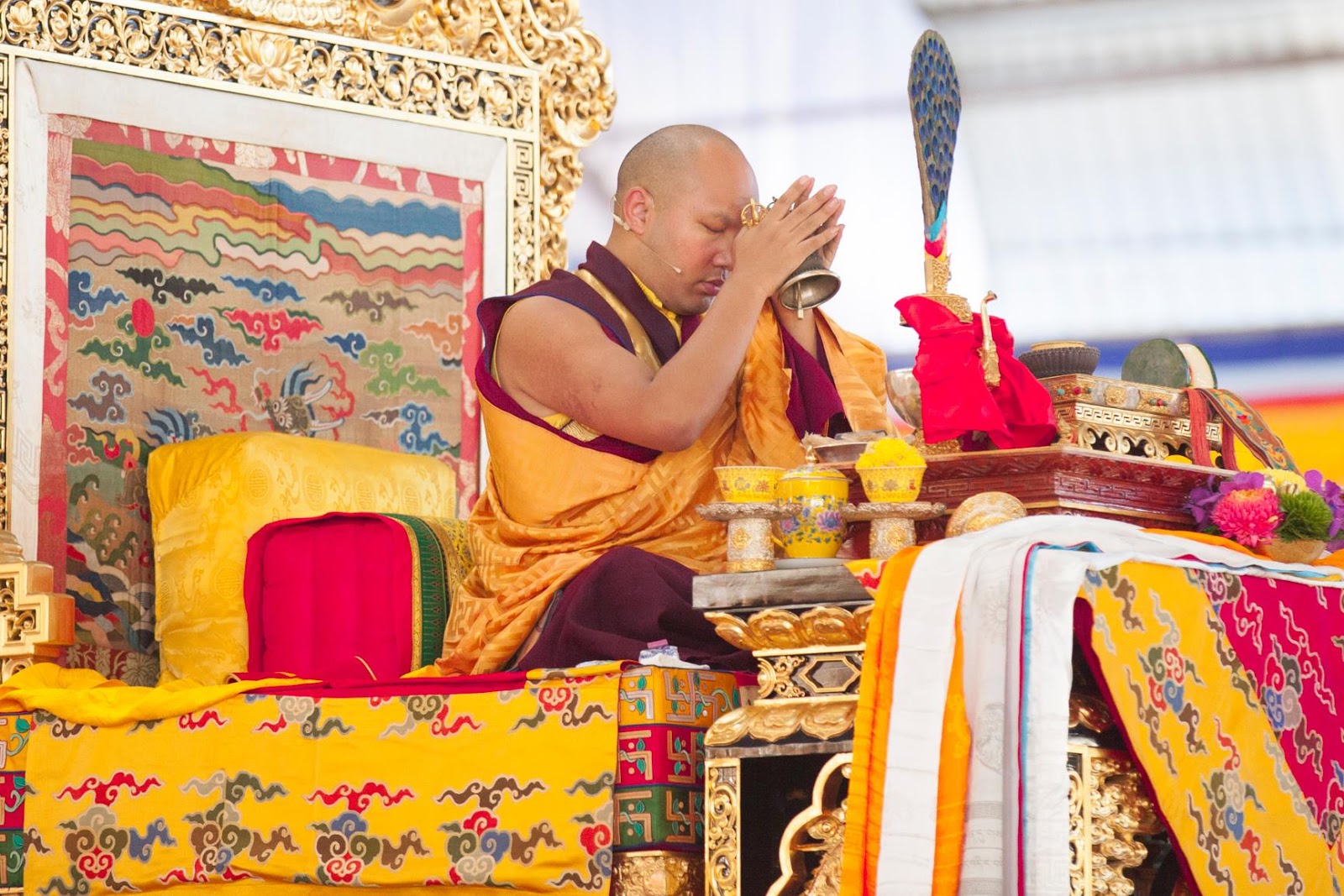
HH 17th Karmapa
Ogyen Trinley Dorje

Monday, March 13, 2017

How long does the relationship with the guru last?


When we have devotion for the guru, it is not just for a single lifetime, but life after life and birth after birth, and we should release ourselves from the binds of hope and
fear.
The relationship with the guru should span many lifetimes, but if we do not do any of the dharma practices, then it will be difficult to follow him from life to life.
HH 17th Karmapa
Ogyen Trinley Dorje


Sunday, March 12, 2017

What can we expect from our relationship with the guru?


3. Resolve to stop expecting or worrying.

We should not have expectations, nor hope to get something out of our relationship with the guru as if it were a business deal. 

We should recognize that our own devotion is our responsibility--a task that we must undertake ourselves. It should not be the case that if the lama treats us in one way we will have devotion and if he treats us in another, we will not.


HH 17th Karmapa
Ogyen Trinley Dorje


Saturday, March 11, 2017

In cultivating devotion, how should one regard the guru?


2. Think that everything the guru does is positive.
The second point is from a positive point of view: we should see everything the guru does as a quality and as an opportunity to train our minds. I think this is the basic meaning. So no matter what the connection between the guru and disciple, do not let it go to waste. See everything that happens as a way to train the mind and improve oneself. Look for the opportunity to do that.

Basically, the trust between the guru and disciple should be indestructible; it should be stable and lasting, and something to have true confidence in. Even in society, when a man and woman really love each other, their connection cannot be harmed or destroyed by any other circumstance. It is like a vajra rock.

HH 17th Karmapa
Ogyen Trinley Dorje


Friday, March 10, 2017

What does it mean to not find fault with the guru?


1. Do not think of the guru’s faults.

There is a difference between what is taught in the texts and reality. If we examine the situation carefully, no one is wholly positive or negative: everyone has a mixture of faults and qualities. So it is hard to find a perfect guru. It is not like we can take the text in our hands and go looking for the perfect guru, comparing him with the text, ticking off qualities: he has got this one, he has got that one. We cannot do that.

It is also important to understand the purpose and reasons for serving the guru. For example, when bees collect pollen from flowers, they know exactly what their task is and they do it perfectly. In this example, the guru is like the flower and the captivating qualities of the guru’s mind are like the pollen that must be retrieved. Moreover, when bees collect pollen from flowers, the colour of the flower is irrelevant, nor does it matter if the flower is beautiful or not. The most important thing is the pollen that they need to obtain. 

We should become close to the spiritual master and cultivate a mutual connection with them. 

HH 17th Karmapa
Ogyen Trinley Dorje


Thursday, March 9, 2017

What is required to take devotion as the path?


In particular there are four points for taking devotion as the path:

1. Do not think of the guru’s faults.
2. Think that everything the guru does is positive.
3. Resolve to stop expecting or worrying.
4. Always have a pure and admiring attitude.


HH 17th Karmapa
Ogyen Trinley Dorje


Sunday, February 26, 2017

What is the impact of the materialistic philosophy of the West on interacting with Buddhist teachers?


In this 21st century, we have become very materialistic, so that we also regard this blessing as a material thing. I want this blessing, and then the teacher give it, and now I’ve got it. This is not the way, blessing is not something that is given, and then you have it and that is it. Blessings are kind of a long-term thing, which kind of slowly builds up.  Maybe you have met a lama and received teachings. Three years go by, nothing happens, there is nothing special. But perhaps, after three years, you think back and you realize something did happen at that time, or something occurs to you now about that time. It takes time. It is not the material way of doing things.

We have such a strong material mentality that we think that Dharma practice also is done in that way; that you just give something or receive something and the transaction is finished. Blessings, Dharma practice and the materialist approach do not operate with the same principles.  Sometimes we do not have patience, we just want it now, we just go and get it from lama, and lama just gives it. Dharma practice does not happen in that way; it is something that has to be slowly cultivated and developed. It happens slowly, this absorbing of qualities within yourself.

HH, 17th Karmapa
Ogyen Trinley Dorje


Saturday, February 25, 2017

What are blessings?

That is what I understand by blessing. So this blessing, when you say blessing, there is nothing to be seen. But there is something to be received. That is what I feel. I sometimes feel that children and parent are together, although parents do not do anything specific, the children feel confident and protected in a certain way. I feel that is a kind of blessing.

So when you receive blessing from teacher or lama, this is something that happens in my life also. Sometimes I have disturbed state of mind, lots of things going on in my mind, and then I go to see one of the lamas or teachers. After discussing things, being with him for a while, without doing anything special, when I return, my mind is peaceful and all the disturbances are pacified, I feel good, relieved, in peace. I feel that this is blessing. 

This is a kind of blessing, when a lama has lots of kindness, compassion, and positive qualities; somehow, students, slowly, step by step, absorb those qualities in themselves. I feel that this is blessing. I do not know of any other blessing than that. If someone else has something else that is called blessing, some object that you can give someone, than I do not know about that.

HH, 17th Karmapa
Ogyen Trinley Dorje


Friday, February 24, 2017

What is the main point of relationship between student and teacher?

What is the main point of relationship between student and teacher?
In the Kagyu system, the teacher tries to pass on wisdom and compassion - the most important qualities. First the teacher trains in developing these positive qualities, then the teacher tries to pass on these qualities. 

Then the student tries to inherit that, to possess those qualities within themselves. 

That’s what we call receiving the lineage, receiving the kindness and blessings of the teacher. Training in that is the system of Kagyu lineage – that’s what we try to work on. 

That is what I understand as the main relationship of student and teacher.

HH, 17th Karmapa
Ogyen Trinley Dorje


Thursday, February 23, 2017

What does it mean for student to be devoted?


The devotion from the side of the students has two meanings – one is longing, another is true respect. The devotion from he students has these two meanings. When you have a qualified teacher, he has to be inspiring. This teacher has certain qualities, better qualities than yourself, which can inspire you. You see it and it steals your heart, so that you fervently wish to follow that. Those qualities are not about physical qualities – he’s beautiful, charismatic – not those kind of qualities, but inner qualities, like kindness, compassion, things like that.

Because you are inspired by those qualities, you want to aspire to possess or develop those qualities in yourself. With that kind of understanding, a natural strong respect or devotion arises in you. 

It is not just saying good things, or just showing outside respect.

It is not about outer things. It is about recognizing the great qualities that the teacher has, those positive qualities that the student really fervently wishes to develop in themselves. 

How much one can absorb those qualities in one’s self – that is a sign of how much devotion one has, how much devotion is understood.

HH, 17th Karmapa
Ogyen Trinley Dorje


Wednesday, February 22, 2017

What is the purpose of the kindness of the teacher?


The kindness of the teacher is not just to free the student from gross problems and pains and sufferings. It is not only to give students happiness, pleasure, or success, worldly kinds of progress. These things may be temporarily seem like happiness or success, but eventually, these are also source of suffering. Therefore, when teachers, the true kindness of the teacher, what they really wish for the students is to go to the root cause, the seed of the sufferings, the teacher wishes to really uproot the cause and the seed of the sufferings – the kleshas and ignorance. 

That’s what the teacher’s intention is. And the students should know that, when you receive instructions, guidance, what the teacher is mainly focusing on is how to decrease, uproot, completely sever the root of the causes of sufferings. 

That is how all instructions and guidance should be seen.


HH, 17th Karmapa
Ogyen Trinley Dorje

Tuesday, February 21, 2017

How should the kindness of the teacher toward student be properly understood?


This kindness of the teacher, the love, affection of the teacher, we have to understand very deeply, because there are many ways of looking at that. Sometimes, we look at this affection or love of teacher just like worldly love or affection. Then we can feel that lama is more loving this person, more affectionate to this person because he is teaching him more, and not teaching me, and doing this to that person, and not too much to me. This kind of problem can arise.

Therefore it is important to understand what the love, affection, and kindness of the teacher really is.

HH, 17th Karmapa
Ogyen Trinley Dorje


Monday, February 20, 2017

In Tibetan Buddhism, how do teacher and student relate to one another?


The relationship between teacher and students is based on two things – one is the blessings or kindness of the teacher, and the other is the devotion or openness of the students.


When you talk about thug-rje or blessings of lama, mainly it is compassion or affection of teacher.  Generally, in life, there are many different kinds of affection – the affection of parents for children, the affection of friends, of family, and things like that. And this affection of the teacher towards the student, it is very important when you are practicing the Dharma.


HH, 17th Karmapa
Ogyen Trinley Dorje


Sunday, February 19, 2017

What is guru yoga?

We have four main schools of Buddhism in Tibet, and most of them belong to the later spread of Buddhism. In all of them, guru yoga – or the relationship between teachers and students – is considered very important.

This guru yoga practice is to have a very special and strong
relationship between teacher and student. It is not just a physical level relationship – the teacher is giving teachings and the student is listening. It is something even deeper than that, something very intimate, spiritual, a very inner relationship, very deep relationship. It is not merely physical, it exists much deeper than that.

HH, 17th Karmapa
Ogyen Trinley Dorje